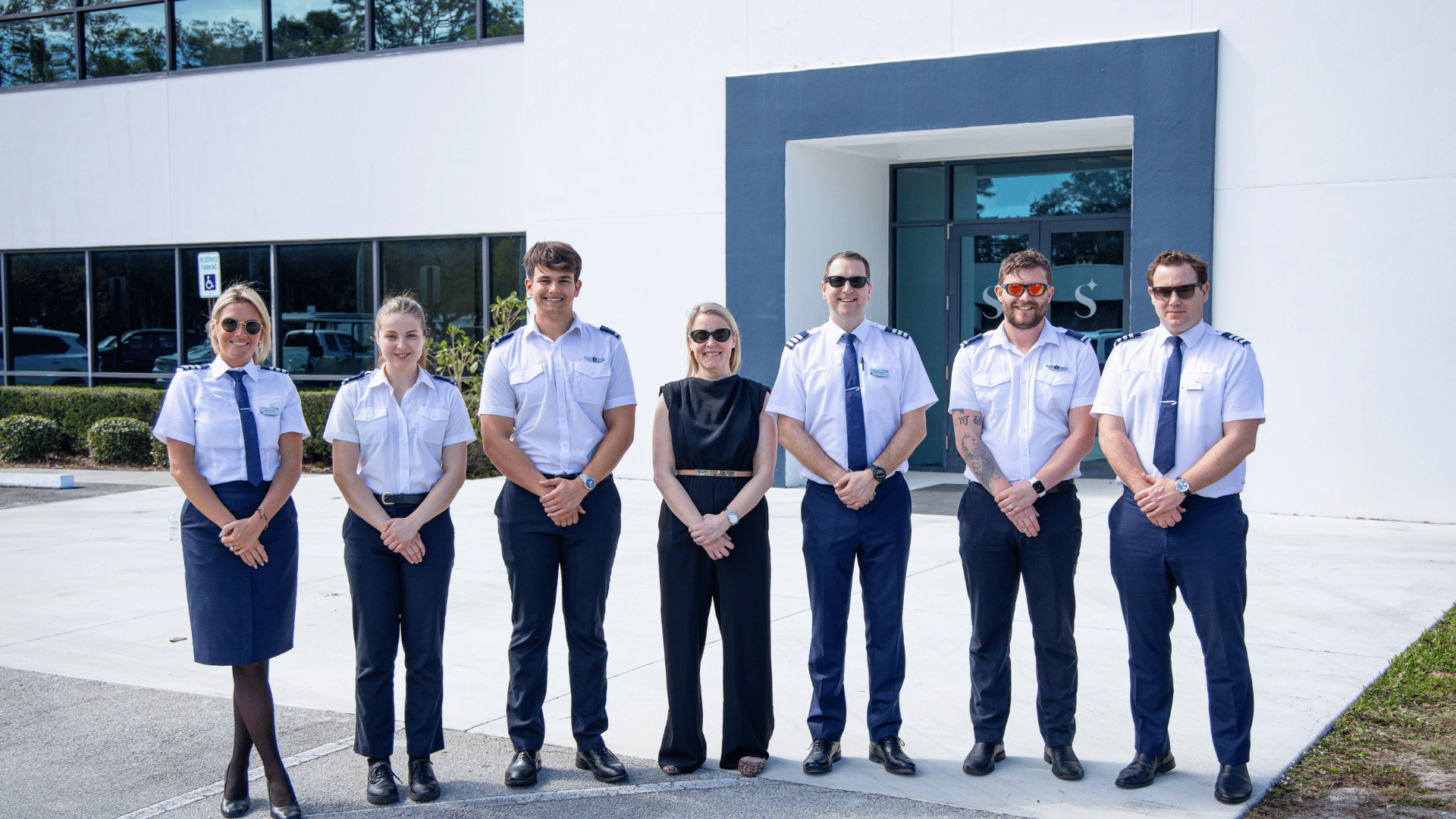
British Airways received more than 40,000 applications this year for its fully funded Speedbird Pilot Academy, underlining the appetite for flying careers and the barrier that training costs have long posed.
The airline is investing £18 million to put 160 people through the programme, with training delivered by partner flight schools including Skyborne Airline Academy.
INTERVIEW: British Airways’ pilot training scheme draws 40,000 applicants amidst push to remove cost barriers
Simon Cheadle, director of flight operations at British Airways, said the academy protects the airline against the ups and downs of pilot recruitment. “We’re in a period of aviation growth at the moment, where a lot of airlines are growing, and the academy gives us a long-term, stable, sustainable supply,” he said.
He said pilot lead times are far longer than for other roles, and that cost of entry is the main obstacle.
Cost issue
“There’s a huge barrier to entry with the £100,000 cost for pilot training,” Cheadle said, referring to ab initio training.
This refers to a structured programme taking individuals with no flying experience to start becoming qualified commercial airline pilots. “We find that cost inhibits us getting access to the whole range of skills and abilities that exist out there.”
The concern is shared across the industry. The British Air Line Pilots’ Association (BALPA), which represents more than 10,000 UK pilots, urged Prime Minister Andy Burnham’s government to work with the aviation industry on changes to the UK pilot apprenticeship scheme, arguing that training costs remain a significant barrier. Acting general secretary Zohra Francis said the cost can stop young people pursuing the career despite having the ability and ambition. “I’m asking the Government to sit down with BALPA, the airlines and stakeholders to iron out the problems and make the pilot apprenticeship work,” she said, “so that everyone with the right potential and ambition, regardless of their background, can have a real chance of becoming a pilot.”
A three-stage funnel
Of BA’s 160 places, ten are reserved for existing colleagues. The remaining 150 are allocated to flight school partners.
Cheadle said the process has three stages. The first is a two-way match between the applicant’s skills and the role, including automated verbal and numerical reasoning tests and an assessed personal statement. That reduces the field to about 800 candidates, who go through the partner schools’ own assessments. Between 300 and 400 return for British Airways’ final assessment, which selects the 150 successful applicants, Assessment runs from around February or March to September or October.
Cheadle said the airline has worked to remove bias, using smaller group exercises, which “tends to remove any inadvertent gender bias,” and speedy interviews.
Skyborne’s approach
Lee Woodward, CEO of Skyborne, began his own career as a British Airways cadet in 1989 on a full scholarship. He said he came from a background that “wouldn’t have had a hope in heck of becoming an airline pilot”, and called the experience “personally transformative”.
A sponsored scheme, he said, lets Skyborne draw on “incredibly diverse backgrounds where the barrier to entry that is funding doesn’t prevail”. The focus is “airline readiness”.
Over 19 to 20 months, cadets are “incrementally building that airline pilot”, with character, professionalism and integrity developed alongside technical skill.
The programme starts with seven months of ground school covering 13 subjects and 750 hours of classroom and computer-based training, at Skyborne’s Gloucestershire or Bournemouth facilities.
Cadets then spend about seven months at Vero Beach, Florida, flying single-engine aircraft through private and commercial pilot training. They return to the UK for around four months of multi-engine instrument rating training, followed by a four-week APS MCC course before joining the airline.
Woodward said Skyborne’s approach is almost identical for all airline customers, with tailoring towards the end, such as adapted checklists and standard operating procedures.
Skyborne also works with other airlines such as easyJet, Jet2.com and Ryanair for pilot training, though not all of these training programmes are fully sponsored by those airlines.
Beyond technical ability
Cheadle said technical flying ability is “only a third of that equation”, alongside leadership and the ability to manage workload and stress.
With funding removing the upfront cost, the academy has recruited everyone from school leavers to people in their 50s changing careers, including former cabin crew, engineers and ground staff. “Having a range of backgrounds and experiences can help deal with any situation,” he said.
Data-led training
Both executives expect training to become more individualised.
Cheadle said simulators are now “incredibly realistic” and VR may have a role, but he expects “an iterative progression rather than a wholesale change.”
Woodward said Skyborne is installing an airline-standard flight data monitoring system across its fleet, feeding its safety management system so findings shape training. A Vero Beach working group of three local airlines has changed procedures based on Skyborne’s data. Describing himself as “quite a cynic” about AI and VR, he said Skyborne nonetheless wants to be among the first flight schools to bring competency-based and evidence-based training to ab initio level.